

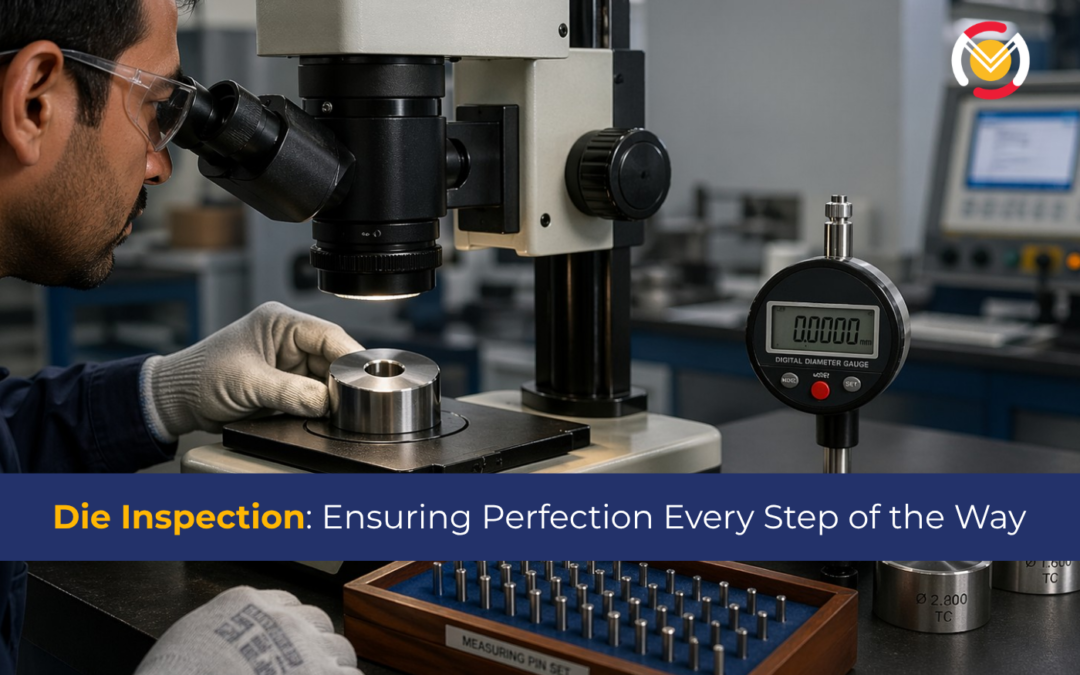
Die inspection ensures that every die used in manufacturing meets exact size, shape, and surface standards. This process helps maintain product consistency, reduce defects, and improve production efficiency. Die inspection checks whether a die is accurate, smooth, and ready for reliable production.
Key Highlights:
1. Ensures dimensional accuracy across production
Every die is verified against required specifications, helping maintain precise output and reducing variation in the final product.
2. Maintains consistent product quality over time
Inspection helps ensure that each production cycle delivers uniform results, which is essential for industries that rely on repeatability.
3. Detects surface defects before production begins
Early identification of scratches, irregularities, or imperfections prevents these issues from affecting the final output.
4. Extends the operational life of dies
Regular inspection helps monitor wear and ensures timely maintenance, reducing the need for frequent replacements.
5. Improves overall production efficiency and control
With verified dies, production runs more smoothly, reducing interruptions and increasing confidence in operations.
Introduction:
Every manufacturing process begins with intent. The goal is always clear:
produce consistent, high-quality output. Yet somewhere along the way, small inconsistencies start appearing. A slight variation in size, an unexpected surface issue, or a drop in performance. That moment shifts attention toward precision.
A manufacturer begins asking deeper questions. Is the die accurate? Is the surface refined enough? Is the geometry aligned with production needs?
This is where die inspection becomes part of the process, offering clarity before production begins and confidence throughout the cycle.
Why is die inspection important in manufacturing?
Die inspection equipment ensures that every die performs exactly as required before entering production.
A die directly influences the final product. Even a small deviation can affect output quality and consistency. Inspection helps identify such variations early.
Key aspects:
1. Dimensional Accuracy: Inspection confirms that the die meets precise measurements required for production. Accurate dimensions ensure that the final product maintains uniform size and meets quality expectations.
2. Surface Quality: A smooth die surface supports better material flow and reduces the chances of defects. Proper inspection ensures that the surface finish aligns with production requirements.
3. Consistency Across Production: Inspection ensures that every die performs in the same way across multiple cycles, helping maintain uniform output and reducing variability.
4. Lesser Errors & Rework: Detecting faults early on in the process means avoiding errors that may occur in other processes down the line.
It makes sure that all dice behave in an identical manner during several cycles to ensure consistency and decrease variations.
What are the tools used for inspecting dies?
Inspection is performed using special tools created for accurate inspection and analysis purposes. Each tool has its own specialty related to accuracy.
Common tools used:
1. Inspection Microscopes: These microscopes provide a detailed view of the die profile, allowing operators to closely examine surface quality and geometry with high clarity.
2. Carbide Die Microscopes: These tools are designed to inspect tungsten carbide dies, helping measure reduction angles and internal structures accurately.
3. Digital Diameter Gauge (DDG): DDG systems enable quick and precise measurement of die sizes, allowing operators to verify dimensions efficiently during inspection.
4. Measuring Pin Sets: Measuring pins offer a reliable method to check bore sizes and internal diameters, ensuring accuracy in critical areas.
Together, these tools create a comprehensive inspection system that covers every detail.
How does the inspection process work step by step?
Structured process guarantees that everything will be inspected before going into production.
Steps in the Process
Step 1: Inspection Under Visuals
The die will be inspected visually through magnifying glass, and any scratch or irregularities on the edges of its surface will be noted.
Step 2: Dimension Inspection
Size and dimensions will be measured by using special measuring devices. The die will be compared against the exact requirement for production.
Step 3: Geometry Inspection
Critical points like the reduction angles and bearing lengths will be checked to verify that it corresponds to the design specifications.
Step 4: Surface Inspection
The quality of the surface will be checked, especially the smoothness since it affects the movement of the material while in production.
Step 5: Approval
Only dies that pass inspection will be used in production.
For a better understanding of die accuracy and performance, this study on the World Scientific website explains how proper measurement and inspection improve results. It also highlights the importance of maintaining die quality for consistent production.
What challenges does this process help solve?
It is quite common for manufacturers to encounter recurrent problems with regards to their products but cannot pinpoint the problem. In most cases, variations in output, scratches, and odd machine reactions can be attributed to problems with die accuracy. Die Inspecting Equipment will provide an initial step towards identifying any problem area.
Common problems encountered:
Variation in Output: Even slight changes in size of the die itself may lead to inconsistencies in size of the manufactured product. Inspection will ensure that all dies meet specified requirements.
Scratches on the Product: Imperfections in terms of coatings on the die itself could lead to scratches on the produced product. Inspection will allow identifying the problem before it affects the final outcome.
Die Wear: Regular use of the die will cause gradual wear that may affect its performance negatively. Regular inspection will facilitate necessary adjustments.
Production Downtime Due To Unexpected Failure: Problems like these could arise from unseen issues in the dies. They can cause unexpected failures in the manufacturing process. By inspecting each die prior to its use, this potential issue will not occur.
This helps ensure control over the manufacturing process.
How does inspection improve productivity?
Inspection helps boost productivity because all dies entering the production phase have been tested for their ability to produce results.
Benefits of productivity include:
Increased Production Speed: Pre-testing of dies ensures that production goes smoothly because there will be no need for continuous adjustments.
Less Number of Defective Products: Accurate dies produce consistently, which means lower rejection rates and less wastage of resources.
Effective Utilization of Resources: Inspected dies reduce instances of mistakes, thus ensuring effective use of resources, including manpower and machines.
Greater Confidence While Operating: Employees can easily operate when they know that all dies being used in the process have been verified for accuracy.
Inspection plays an important role in helping boost productivity in a subtle way.
How does inspection support long-term quality?
Maintaining consistency through time is one of the toughest jobs in manufacturing. Inspection has an ongoing role in making sure that all dies will conform to the same standards for their entire life cycles.
Advantages Over Time:
Consistency of Output Quality from Batch to Batch: Routine inspections guarantee consistency among all batches of dies during production cycles.
Increased Dies’ Longevity with Proper Monitoring: Routine inspections allow manufacturers to monitor their dies. This way, they can make decisions about necessary actions to prolong their lives.
Reduced Replacement and Maintenance Expenses: With routine inspections, any problems with dies can be discovered in time. It reduces replacement needs.
Building Strong Client Relations: Consistent quality outputs are key to building strong relations with clients because they ensure reliable products.
Inspection becomes a foundation for maintaining quality over extended production cycles.
Why choose Mikrotek for die inspection solutions?
Mikrotek supports manufacturers with reliable and precise solutions for die inspection, helping ensure accuracy at every stage of production. With advanced inspection microscopes, digital measurement systems, and practical tools designed for shop floor use, Mikrotek makes it easier to verify die quality with confidence. Mikrotek solutions help maintain consistency, reduce variation, and improve overall production control, making Mikrotek a trusted partner for manufacturers focused on precision and long-term quality.
The journey gradually unfolds:
- Starting with a focus on production volume and speed
- Observing inconsistencies in output and performance
- Identifying the die as a critical factor in quality
- Exploring methods to improve accuracy and reliability
- Adopting inspection practices as a standard process
- Achieving stable, predictable, and high-quality production
This journey reflects how inspection becomes an essential part of manufacturing maturity. What begins as a reactive step eventually becomes a proactive practice that supports long-term success.
FAQs
1. What is die inspection in manufacturing?
Die inspection is the process of examining a die for dimensional accuracy, surface finish, and geometry before production begins. This helps ensure consistent output quality and reduces the chances of defects during manufacturing.
2. Why is die inspection important for product quality?
Die inspection ensures that the die used in production meets required standards. Accurate dies lead to uniform products, smooth finishes, and reliable performance, which are essential for maintaining quality across production cycles.
3. How does die inspection improve production efficiency?
Die inspection helps identify issues before production starts, reducing the need for adjustments, rework, and downtime. This leads to smoother operations, faster production cycles, and better use of resources.
4. What tools are commonly used in die inspection?
Die inspection uses tools such as microscopes, digital diameter gauges, and measuring pin sets. These tools help evaluate surface quality, measure dimensions, and verify geometry with precision.
5. How often should it be performed?
Die inspection should be carried out before production and at regular intervals during usage. Frequent checks help detect wear early and ensure that the die continues to perform accurately over time.
6. Can die inspection help extend the life of a die?
Die inspection helps identify early signs of wear or damage, allowing timely maintenance or repolishing. This extends the lifespan of the die and reduces the need for frequent replacements.
7. What happens if die inspection is skipped?
Skipping die inspection can lead to inconsistent product quality, increased defects, and unexpected production issues. This may result in higher rejection rates, material wastage, and increased operational costs.
8. Which industries rely heavily on die inspection?
Industries such as wire manufacturing, electronics, automotive, and aerospace depend on die inspection to maintain precision and consistency, as even small variations can impact performance and reliability.
9. How does it support long-term manufacturing success?
Die inspection ensures consistent quality, reduces failures, and improves operational efficiency over time. This helps manufacturers maintain stable production and build trust with customers through reliable output.
10. How can the right inspection system improve overall operations?
A well-structured inspection system provides accurate data, reduces uncertainty, and improves decision-making. This leads to better control over production processes and supports continuous improvement in manufacturing.
