

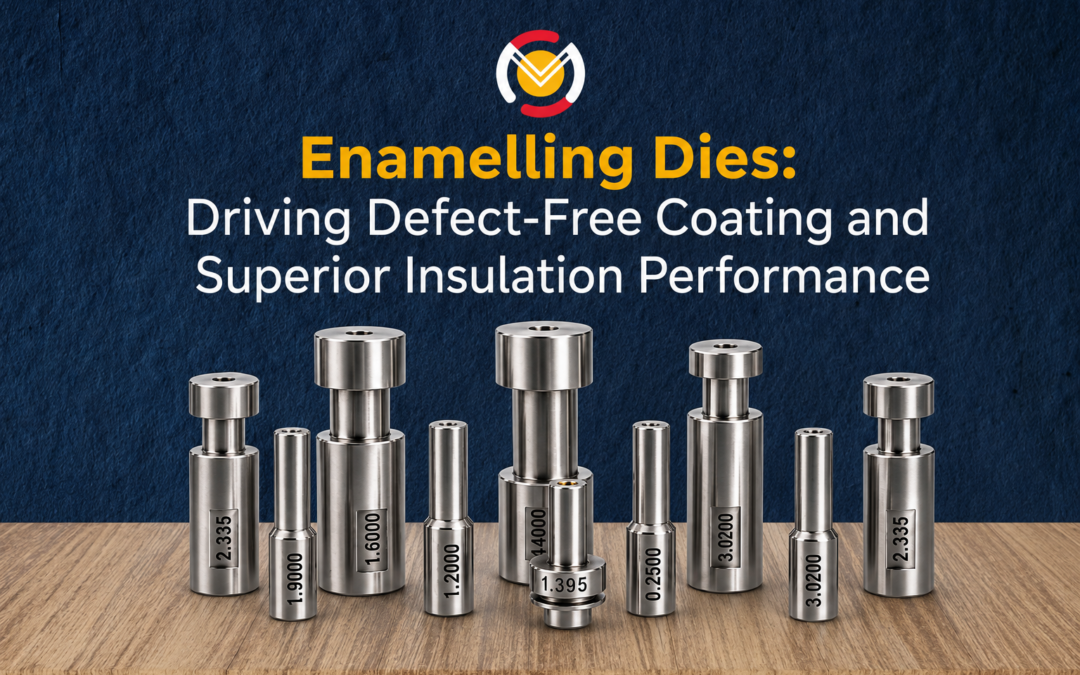
In the modern wire and cable industry, product quality begins long before the finished conductor reaches the customer. Every stage of manufacturing contributes to the final performance, but one of the most influential components is often the smallest—the enamelling die.
Whether manufacturing magnet wire for electric motors, transformers, generators, electric vehicle systems, or consumer electronics, the quality of the enamel coating directly determines electrical insulation, thermal endurance, and long-term reliability.
Precision enamelling dies ensure that every layer of enamel is applied accurately, consistently, and efficiently throughout the production process. As industries continue demanding higher efficiency, improved electrical performance, and greater production speeds, selecting the right enamelling die has become more important than ever.
What Is an Enamelling Die?
An enamelling die is a precision-engineered tool used during the wire enamelling process to control the exact amount of enamel coating applied to copper or aluminium conductors.
Mikrotek enamelling dies are available for conductor sizes ranging from 0.100 mm to 6.00 mm, subject to the selected die material, machine configuration, and production requirements.
These dies regulate coating thickness with exceptional accuracy, helping manufacturers achieve:
- Uniform insulation thickness
- Smooth enamel surface finish
- Consistent dielectric performance
- Reliable electrical insulation
- Superior winding characteristics
Although physically small, the enamelling die plays a major role in determining the overall quality of the finished magnet wire.
Why Enamelling Die Precision Matters
During production, conductors pass through multiple coating and curing cycles. At every stage, the enamelling die precisely meters the enamel before the conductor enters the curing furnace.
Even the slightest variation in bore geometry, concentricity, dimensional accuracy, or surface finish can result in:
- Uneven insulation thickness
- Surface defects
- Pinholes and voids
- Reduced dielectric strength
- Increased production rejects
A precision-manufactured die ensures stable coating conditions throughout the production run, minimizing defects while improving manufacturing efficiency.
Understanding the Enamelling Process
Every conductor follows a carefully controlled production sequence:
The die performs the most critical function during the metering stage by controlling the amount of enamel applied during every pass.
This precise control helps ensure:
- Uniform circumferential coating
- Stable enamel flow
- Consistent layer build-up
- Excellent insulation performance
Premium Die Materials for Every Application
Different production requirements demand different die materials. Mikrotek offers precision enamelling dies using PCD, tungsten carbide, and natural diamond inserts to meet different wire-size, production-speed, surface-finish, and tool-life requirements.
PCD Enamel Dies (Polycrystalline Diamond)
PCD enamelling dies deliver exceptional wear resistance, dimensional stability, and long operating life.
Their mirror-polished surface provides:
- Superior coating consistency
- Excellent surface finish
- Longer operating life
- Minimal maintenance requirements
PCD dies are highly recommended for wire sizes below 1.500 mm, particularly on high-speed enamelling lines. They are also suitable for larger wire sizes where extended tool life and consistent production performance are essential.
Tungsten Carbide (TC) Insert Enamelling Dies
Tungsten carbide insert enamelling dies provide a cost-effective and dependable solution for standard production requirements.
Their principal benefits include:
- Excellent value
- Reliable production performance
- Stable dimensional accuracy
- Suitability for wire sizes above 0.200 mm
These dies are widely used in general-purpose enamelling applications where productivity, performance, and operating cost must remain balanced.
Natural Diamond (ND) Enamel Dies
Natural diamond enamel dies represent the highest level of surface finish and precision.
They offer:
- Exceptional hardness
- Ultra-smooth mirror finish
- Superior dimensional accuracy
- Outstanding performance for ultra-fine wire production
Natural diamond dies are particularly suitable for manufacturers producing premium-quality magnet wire with extremely demanding insulation, dimensional, and surface-finish requirements.
Preventing Common Coating Defects
Precision die engineering helps prevent many of the defects commonly encountered during enamel coating.
Pinholes and Voids
Mirror-polished die bores promote uninterrupted enamel flow and reduce the risk of coating interruptions that may create pinholes or voids.
Surface Blistering
Optimized die geometry supports smooth enamel flow and minimizes unnecessary stress on the coating layer.
Uneven Insulation Thickness
High concentricity and dimensional stability help maintain consistent insulation thickness throughout production.
Surface Irregularities
Uniform enamel metering produces smooth, consistent, and defect-free coatings across the complete conductor circumference.
Custom Solutions for Every Enamelling Machine
No two production lines are identical. Enamelling dies can therefore be customized to match specific machine configurations, production speeds, wire dimensions, and coating requirements.
Available configurations include:
- Vertical enamelling machines
- Horizontal enamelling machines
- Steel body designs
- Brass body designs
- Aluminium body designs
- Custom body configurations
Customized die solutions help manufacturers achieve maximum productivity, coating consistency, and process stability across different production environments.
Industries That Depend on Precision Enamelling Dies
High-performance enamelling dies are used across numerous industries where electrical insulation quality, reliability, and dimensional consistency are critical.
Typical applications include:
- Magnet wire manufacturing
- Electric motors
- Power transformers
- EV motors and charging systems
- Renewable energy equipment
- Aerospace and defence
- Telecommunications
- Industrial machinery
- Consumer electronics
- Compressors and generators
Why Precision Enamelling Dies Matter More Than Ever
With the rapid growth of electric vehicles, renewable energy systems, automation, and high-efficiency electrical equipment, manufacturers face increasing expectations for product quality and reliability.
Every improvement in coating uniformity directly contributes to:
- Better dielectric performance
- Improved thermal endurance
- Reduced production waste
- Higher manufacturing efficiency
- Longer product life
- Greater customer satisfaction
Better dies produce better wire.
Conclusion
An enamelling die may be one of the smallest components in a wire production line, but its impact extends throughout the entire magnet wire manufacturing process.
From achieving uniform insulation thickness to improving process stability and reducing production defects, precision enamelling dies are essential for producing high-quality magnet wire that meets today’s demanding electrical and industrial standards.
Investing in high-performance PCD, tungsten carbide, or natural diamond enamelling dies is not merely a tooling decision—it is an investment in product quality, manufacturing efficiency, and long-term customer confidence.
Looking for Precision Enamelling Dies?
Mikrotek manufactures PCD, tungsten carbide, and natural diamond enamelling dies engineered for consistent coating, dimensional stability, and reliable production performance.
Discuss your wire sizes, machine configuration, production speed, and coating requirements with the Mikrotek team.
Frequently Asked Questions
1. What is an enamelling die?
An enamelling die is a precision tool used to regulate the amount of enamel coating applied to copper or aluminium wire during the magnet wire manufacturing process.
2. Why is die precision important in enamelling?
Die precision ensures uniform insulation thickness, smooth coating, improved dielectric strength, and fewer manufacturing defects.
3. What wire sizes can enamelling dies accommodate?
Premium enamelling dies are available for wire sizes ranging from 0.100 mm to 6.00 mm, depending on the die material, machine configuration, and production requirements.
4. What materials are used to manufacture enamelling dies?
The most common materials are polycrystalline diamond (PCD), natural diamond (ND), and tungsten carbide (TC). Each material offers different advantages for production speed, wire size, surface finish, cost, and operating life.
5. Which die material offers the longest service life?
PCD enamelling dies generally provide the longest service life because of their exceptional wear resistance and dimensional stability.
6. Which industries use enamelling dies?
Enamelling dies are widely used in magnet wire manufacturing, electric motors, transformers, EV systems, renewable energy equipment, telecommunications, aerospace, industrial machinery, compressors, generators, and consumer electronics.
7. Can enamelling dies be customized?
Yes. Enamelling dies can be customized with different body materials, bore profiles, dimensions, and configurations to suit specific production machines and coating requirements.
8. What defects can precision enamelling dies prevent?
High-quality enamelling dies help prevent pinholes, uneven insulation thickness, blistering, surface irregularities, and inconsistent coating build-up.
9. How do PCD enamelling dies improve production efficiency?
PCD dies reduce wear, minimize downtime, maintain dimensional accuracy, and provide consistent coating quality during high-speed production.
10. Why choose Mikrotek Enamelling Dies?
Mikrotek manufactures precision-engineered enamelling dies using premium materials and advanced manufacturing techniques. These dies deliver exceptional coating consistency, longer tool life, dimensional stability, and reliable performance for demanding wire manufacturing applications.
