
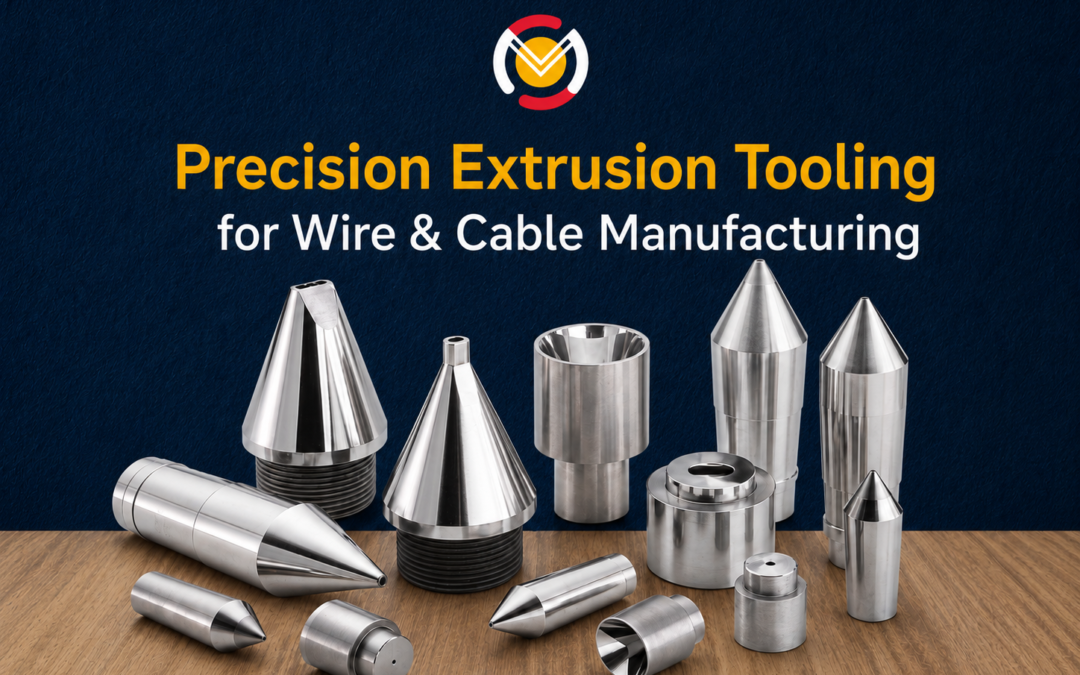
In modern wire and cable manufacturing, extrusion tooling plays a critical role in achieving consistent insulation thickness, conductor centering, dimensional accuracy, and surface quality.
As cable production speeds continue to increase and manufacturers face tighter dimensional specifications, the performance of extrusion dies, tips, and allied tooling becomes increasingly important.
A precision-engineered tooling system helps control polymer flow around the conductor while maintaining the required geometry throughout the extrusion process. Correct tooling design, alignment, material selection, surface finish, and dimensional accuracy can contribute significantly to stable production and consistent cable quality.
For manufacturers producing insulated wires, power cables, automotive cables, communication cables, and specialty cables, precision extrusion tooling is an important part of the overall manufacturing process.
What Is Extrusion Tooling?
Extrusion tooling refers to the precision components used to control the flow and final geometry of polymer insulation or jacketing around a conductor.
The primary components include the extrusion die and tip, supported by various allied tooling components depending on the extrusion system and application.
The tip positions and guides the conductor, while the die controls the shape, dimensions, and final coverage of the extruded polymer.
Together, these components must work in precise alignment to achieve stable material flow and consistent insulation coverage.
The Extrusion Die and Tip: The Heart of the Tooling System
The extrusion die controls the external dimensions and shape of the insulation or cable jacket, while the tip guides the conductor through the extrusion process.
Their performance directly affects several critical cable characteristics:
- Conductor centering
- Insulation wall thickness
- Concentricity
- Dimensional accuracy
- Polymer flow stability
- Surface finish
- Material consumption
- Production consistency
Even small deviations in tooling geometry or alignment can result in eccentric insulation, uneven wall thickness, surface imperfections, dimensional variation, and increased polymer consumption.
Therefore, precision manufacturing and accurate die-tip alignment are essential for maintaining stable extrusion performance.
Why Die-Tip Alignment Matters
One of the most important considerations in cable extrusion is conductor centering.
The conductor must remain correctly positioned within the polymer flow to achieve uniform insulation coverage around its circumference.
Poor alignment can result in:
- Uneven insulation thickness
- Increased eccentricity
- Reduced dimensional consistency
- Excessive polymer consumption
- Surface irregularities
- Increased process adjustments
Proper die-tip alignment helps maintain controlled polymer distribution and consistent insulation thickness.
For high-speed production lines, even small alignment errors can become significant because the extrusion process continuously operates at high throughput.
Material Selection for Extrusion Dies and Tips
The material used for extrusion tooling should be selected according to the application and operating process.
Depending on the extrusion process and tooling requirement, commonly used materials include:
- PCD
- Tungsten carbide
- High-speed steel
- Stainless steel
Material selection should consider several factors rather than hardness alone.
Wear Resistance
Continuous production can cause wear on tooling surfaces. Appropriate material selection helps maintain critical dimensions and tooling geometry over extended production periods.
Toughness
Tooling must withstand mechanical stresses during production, handling, installation, and operation.
Polishability
A highly refined tooling surface can support smoother polymer movement and help minimize surface defects.
Chemical Compatibility
The tooling material and surface condition should be suitable for the polymer and additives used during extrusion.
Operating Conditions
Production speed, temperature, pressure, polymer characteristics, and application requirements should all be considered when selecting tooling materials.
Reconditioning Potential
For suitable tooling designs, the ability to recondition or restore working surfaces can contribute to longer overall tooling service life.
The Importance of Surface Finish
Surface finish is an important but sometimes underestimated aspect of extrusion tooling performance.
The working surfaces of the die and tip interact directly with the polymer during extrusion. An accurately machined and properly polished surface can promote smoother material flow and reduce the potential for material build-up and surface imperfections.
A controlled surface finish can contribute to:
- Improved polymer flow
- Better cable surface appearance
- Reduced material accumulation
- Consistent extrusion performance
- Improved tooling service life
For demanding high-speed extrusion applications, surface quality becomes increasingly important as production conditions become more challenging.
Application-Specific Extrusion Tooling
There is no single extrusion tooling configuration suitable for every wire and cable application.
Tooling design may need to be customized according to several important factors.
Conductor
Material, diameter, construction, and flexibility all influence tooling design and conductor guidance.
Cable Construction
Solid, stranded, compacted, or specialized conductor constructions may require different tooling geometries and clearances.
Insulation Material
Tooling can be designed for polymer materials such as PVC, PE, XLPE, LSZH, and other specialized compounds.
Extrusion Process
Single-layer, multi-layer, tandem, or specialized extrusion systems may each require different die-tip configurations.
Production Speed
Higher speeds can increase the importance of polymer-flow stability, heat management, dimensional control, and tooling precision.
Dimensional Requirements
Tighter cable tolerances require increasingly precise tooling design, manufacturing, alignment, and inspection.
Surface Requirements
Applications requiring premium cable appearance may require highly refined working surfaces to support smooth polymer flow and surface quality.
Application-specific engineering is therefore essential for achieving optimum extrusion tooling performance.
How Precision Extrusion Tooling Improves Productivity
The value of precision tooling extends beyond dimensional accuracy.
A well-engineered extrusion tooling system can contribute to a more stable production process:
Precision Tooling
↓
Stable Polymer Flow
↓
Consistent Insulation Dimensions
↓
Reduced Process Adjustments
↓
Lower Scrap and Rejection
↓
Higher Production Efficiency
When tooling maintains stable performance, operators may spend less time making repeated process corrections.
This can help improve production efficiency while reducing material waste and supporting consistent product quality.
Reducing Material Consumption Through Better Tooling
Material consumption is an important cost factor in cable manufacturing.
Inconsistent insulation thickness or excessive eccentricity can lead to unnecessary polymer usage. Precision die and tip geometry helps maintain the desired insulation dimensions more consistently.
By controlling the relationship between conductor diameter, insulation thickness, die opening, and polymer flow, manufacturers can work toward more efficient material utilization.
Over large production volumes, even small improvements in polymer consumption can have a meaningful impact on overall manufacturing cost.
Extrusion tooling should be evaluated based on its total contribution to production, not only its initial purchase price.
Precision Extrusion Tooling for High-Speed Production
High-speed extrusion places additional demands on tooling performance.
At higher production speeds, manufacturers must maintain stable polymer flow while controlling:
- Conductor centering
- Insulation thickness
- Surface quality
- Dimensional stability
- Temperature conditions
- Material consumption
Tooling precision becomes increasingly important because small variations can affect a larger volume of finished cable when production runs continuously at high speed.
Precision-engineered extrusion dies and tips can therefore contribute to improved process stability and repeatability in demanding production applications.
Quality Control in Extrusion Tool Manufacturing
Precision extrusion tooling requires controlled manufacturing and inspection processes.
Important quality considerations include:
- Dimensional accuracy
- Die and tip geometry
- Concentricity
- Surface finish
- Material quality
- Working-zone condition
- Alignment compatibility
Modern precision manufacturing methods combined with dimensional inspection help ensure that tooling meets the required specifications before being introduced into production.
For customized tooling, application-specific drawings and dimensional requirements should be carefully reviewed to ensure compatibility with the extrusion line and cable construction.
How to Select the Right Extrusion Die and Tip
Selecting the correct extrusion die and tip requires consideration of the complete extrusion application.
Manufacturers should evaluate:
- Conductor diameter and construction
- Insulation or jacket material
- Required insulation thickness
- Extrusion line and tooling configuration
- Production speed
- Dimensional tolerance
- Surface-quality requirements
- Required tooling life
- Specific cable application
Working with an experienced extrusion tooling manufacturer can help ensure that the die and tip configuration is matched to actual production requirements.
Conclusion
In modern wire and cable manufacturing, precision extrusion tooling is fundamental to achieving consistent insulation dimensions, conductor centering, surface quality, and production efficiency.
Extrusion dies and tips must work together with precise geometry, alignment, material selection, and surface finish to control polymer flow and maintain stable cable dimensions.
As production speeds increase and cable specifications become more demanding, the importance of application-specific extrusion tooling continues to grow.
High-quality tooling can contribute not only to improved cable quality but also to lower material consumption, reduced process adjustments, lower scrap, and improved overall production efficiency.
With expertise in extrusion dies, tips, and allied tooling, Mikrotek provides precision-engineered solutions for diverse wire and cable manufacturing requirements.
Better tooling. Stable extrusion. Consistent quality. Reliable production performance.
Looking for Precision Extrusion Dies and Tips?
Mikrotek manufactures precision extrusion dies, tips, and allied tooling engineered for reliable conductor centering, dimensional accuracy, polymer-flow stability, and demanding wire and cable extrusion applications.
Discuss your conductor size, cable construction, polymer material, insulation thickness, production speed, tooling configuration, and dimensional requirements with the Mikrotek team.
Frequently Asked Questions
1. What is extrusion tooling in wire and cable manufacturing?
Extrusion tooling consists of precision components such as dies, tips, and allied tooling used to control polymer flow and form insulation or jacketing around a conductor.
2. What is the function of an extrusion die?
An extrusion die controls the external shape and dimensions of the insulation or cable jacket as the polymer exits the extrusion system.
3. What is the function of an extrusion tip?
The tip guides and positions the conductor within the polymer flow, helping maintain proper conductor centering and insulation coverage.
4. Why is die-tip alignment important?
Correct die-tip alignment helps maintain conductor centering and uniform insulation thickness. Poor alignment can cause eccentricity, uneven insulation, dimensional variation, and increased material consumption.
5. Which materials are used for extrusion dies and tips?
Depending on the application, extrusion tooling can be manufactured using materials such as PCD, tungsten carbide, high-speed steel, and stainless steel.
6. Which cable materials require precision extrusion tooling?
Precision tooling may be used for cables insulated or jacketed with PVC, PE, XLPE, LSZH, and other polymer compounds. Tooling design should be selected according to the specific material and processing conditions.
7. How does extrusion tooling affect cable quality?
Tooling geometry, alignment, material, and surface finish can influence insulation thickness, conductor centering, dimensional accuracy, surface quality, polymer flow, and overall production stability.
8. How can extrusion tooling reduce production costs?
Precision tooling can help reduce excessive polymer consumption, process adjustments, scrap, rejection, and tooling-related downtime, contributing to improved total production economics.
9. How should an extrusion die and tip be selected?
Selection should consider conductor diameter and construction, polymer type, insulation thickness, extrusion speed, dimensional tolerances, surface requirements, tooling material, and the specific extrusion equipment.
10. Why choose Mikrotek Extrusion Tooling?
Mikrotek provides precision-engineered extrusion dies, tips, and allied tooling designed to support conductor centering, dimensional consistency, stable polymer flow, surface quality, and reliable production performance across diverse wire and cable extrusion applications.