

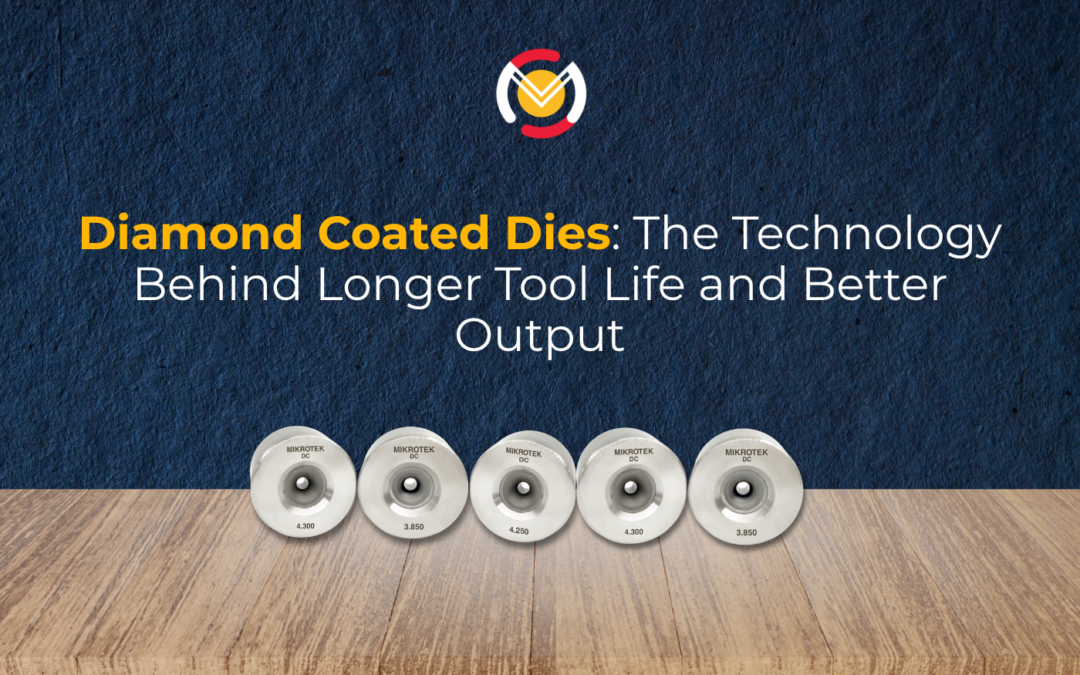
Diamond coated dies are wire-drawing tools with a CVD diamond layer applied to tungsten carbide to reduce friction and wear. They last 10 to 20 times longer than standard carbide dies, lower drawing force, and improve wire surface quality. Used across stainless steel, carbon steel, and nonferrous applications to cut downtime and production costs.
1. Two-Layer Coating Improves Durability: Micro-scale layer provides strength, nano-scale layer reduces friction. The coating is 30 to 40 microns thick and has a hardness up to 7000 HVI.
2. Lower Friction Reduces Drawing Force: Nano-diamond surface reduces contact resistance, requiring less force to pull the wire. This prevents breakage and enables faster, more stable production.
3. Extended Life Cuts Replacement Costs: Dies last 10 to 20 times longer than carbide dies. Fewer changes reduce downtime and tooling costs while simplifying production schedules.
4. Stable Geometry Provides Reliable Quality: Dies maintain shape over long runs, delivering uniform diameter and surface finish. Rejection rates drop, and quality stays consistent across batches.
5. Handles Demanding Applications: Suitable for stainless steel, carbon steel, copper, aluminum, tube drawing, and compacting. Performs well in high-speed and abrasive conditions.
Introduction:
In wire drawing, most dies look identical from the outside. The difference lies inside the bore, where friction, wear, and surface interaction define performance.
For years, tungsten carbide dies have been the standard. Yet, frequent die changes, inconsistent wire finish, and production interruptions continue to affect efficiency.
This is where nano dies, now referred to as diamond coated dies, brings a clear shift. By applying a CVD (Chemical Vapor Deposition) diamond coating over a tungsten carbide substrate, these dies change how friction, wear, and surface quality are managed in production.
Manufacturers across stainless steel, carbon steel, and nonferrous applications are adopting this technology to achieve longer tool life, better output consistency, and lower operational cost.
What Are Diamond Coated Dies (Nano Dies)?
Diamond coated dies are advanced wire-drawing tools in which a CVD-applied diamond composite layer is deposited onto a tungsten carbide die profile under controlled vacuum conditions.
This coating is built with two functional layers:
1. A micro-scale diamond layer for strong adhesion and wear resistance
2. A nano-scale diamond layer for smoothness, reduced friction, and polishability
The coating thickness normally ranges between 30 to 40 microns, with hardness reaching up to 7000 HVI, making it significantly harder than most materials being drawn.
This structure enables the die to maintain its geometry and performance along extended production cycles.
How Diamond Coated Dies Are Manufactured
The production process is highly controlled and critical to performance.
A mixture of carbon source gas and hydrogen is introduced into a vacuum chamber. Under high temperature and low pressure, the gases decompose into active carbon atoms. These atoms deposit onto the tungsten carbide substrate, forming a diamond layer.
Modern systems boost this process through:
1. Plasma-assisted deposition
2. Magnetic field control for uniform coating
3. Automated gas circulation and cooling
This enables consistent coating across multiple dies, including deep bore diameters as small as 0.30 mm, expanding application flexibility.
A ScienceDirect research study on wire drawing processes notes that die wear and surface degradation are directly linked to friction conditions, confirming the importance of coated dies in high-load applications.
Why Friction Matters in Wire Drawing
In any wire drawing operation, friction at the bore surface is the primary cause of die wear.
Traditional carbide dies manage friction indirectly, which leads to:
1. Faster bore wear
2. Increased drawing force
3. Higher chances of wire breakage
4. Frequent die replacement
Diamond coated dies address friction at its source. The nano diamond layer reduces contact resistance, resulting in smoother drawing conditions and significantly improved performance.
Performance Comparison: Diamond Coated vs Tungsten Carbide Dies
The difference in performance is not incremental; it is substantial.
1. Extended Tool Life: Diamond coated dies last 10 to 20 times longer than bare tungsten carbide dies in comparable applications.
2. Reduced Drawing Force: Lower friction reduces the force required to pull wire, improving machine efficiency and decreasing stress on equipment.
3. Improved Surface Finish: Wire exits with a cleaner, more uniform surface, key for precision industries such as electronics, automotive, and medical applications.
4. Reduced Downtime: Fewer die changes translate to fewer stoppages, improving production continuity and schedule efficiency.
Applications of Diamond Coated Dies
These dies are designed for difficult conditions where usual tooling struggles.
They are widely used for:
• Stainless steel wire drawing
• Carbon steel wire drawing
• Copper, aluminium, and nonferrous metals
• Tube drawing applications
• Bunching, stranding, and compacting processes
In abrasive and high-speed environments, diamond coated dies maintain bore accuracy and deliver consistent output across long production runs.
Key Benefits for Wire Manufacturers
Switching to diamond coated dies delivers measurable operational advantages across production, quality, and cost control.
1. Longer Die Life: Extended wear resistance substantially reduces die replacement frequency, minimizing machine stoppages and reducing dependence on manual control during production cycles.
2. Higher Output Efficiency: Stable bore geometry over longer runs ensures uninterrupted production, allowing machines to operate consistently without frequent occurrences of calibrations or unexpected slowdowns.
3. Better Surface Quality: The die’s smooth, low-friction surface produces cleaner, more uniform wire, reducing rejection rates and assuring consistent product quality across batches.
4. Lower Cost Per Unit: Though the initial investment may be higher, the combination of longer die life, reduced downtime, and fewer replacements results in a substantially lower cost per unit of wire produced.
5. Improved Material Utilization: Consistent drawing conditions and dimensional stability help reduce material loss, enabling better utilization of raw materials while improving overall production yield.
How to Evaluate If Diamond Coated Dies Are Right for You
Manufacturers typically consider this shift when facing recurring production issues.
Key evaluation indicators include:
1. Increasing die change frequency
2. Surface quality inconsistencies
3. High drawing force causing breakage
4. Rising cost per unit of wire
A trial run alongside existing tooling is the most effective way to evaluate performance. Standards such as die life, surface finish, and drawing force provide clear, application-specific insights before full adoption.
From Trial to Full Adoption
The transition to diamond coated dies follows a systematic path.
It opens with understanding the wire material, size, and drawing conditions. Based on this, the correct die specification is defined. A trial phase validates performance improvements under real conditions. Once proven, manufacturers gradually shift to full adoption within relevant stages.
Over time, tooling schedules stabilize, downtime reduces, and production becomes more predictable.
How Mikrotek Supports Diamond-Coated Die Performance
Mikrotek’s manufactures diamond coated dies using a controlled CVD vacuum process to ensure uniform coating and strong adhesion across the die profile. Each die is specified based on wire material, size, and drawing conditions, securing consistent performance on the production floor. With proven application across steel, nonferrous, and cable processes, Mikrotek helps manufacturers achieve longer die life, stable output, and predictable production cycles.
Contact Mikrotek to discuss your drawing application and confirm the right nano die specification for your conditions.
FAQs
1. What are diamond coated dies?
Diamond coated dies, also known as Nano Dies, are tungsten carbide drawing dies enhanced with a CVD-applied diamond layer. This coating reduces friction at the bore surface, improves wear resistance, and delivers better wire surface finish throughout extended production cycles.
3. What materials can be drawn using these dies?
Diamond-coated dies are suitable for drawing stainless steel, carbon steel, copper, aluminium, and other nonferrous metals. They perform especially well in abrasive or high-speed applications where typical tooling wears out quickly.
5. What size range is available?
Diamond-coated dies are typically available in a wide size range, from approximately 0.500 mm up to 120 mm. This range supports both fine wire drawing and heavy-duty industrial applications without demanding extensive customization.
7. Is the initial cost justified?
Yes, although the initial cost is higher than conventional dies, the extended tool life, reduced downtime, and improved production efficiency significantly lower the overall cost per unit of wire produced over time.
9. How does Mikrotek ensure consistent quality in diamond coated dies?
Mikrotek uses a controlled vacuum CVD process to achieve uniform coating thickness and strong adhesion. Each die is manufactured with strict process control, assuring consistent bore performance, extended life, and reliable results across production cycles.
2. How long do diamond coated dies last?
Diamond coated dies typically last 10 to 20 times longer than standard tungsten carbide dies. The exact lifespan depends on the material being drawn, operating conditions, and drawing speeds used during production.
4. Do diamond coated dies reduce wire breakage?
Yes, diamond coated dies reduce friction at the contact zone, which lowers the drawing force required. This decreases stress on the wire, reducing breakage rates plus improving stability during continuous production runs.
6. Are they suitable for tube drawing?
Yes, diamond-coated dies are suitable for tube drawing applications. Their ability to handle higher friction loads and maintain dimensional accuracy makes them effective for processes involving larger contact surfaces and tough conditions.
8. How should manufacturers test these dies?
Manufacturers should conduct a trial run alongside existing tooling under actual production conditions. Comparing die life, surface finish, and drawing force provides practical, application-specific data to support a confident transition decision.
10. How does Mikrotek support manufacturers in selecting the right die?
Mikrotek evaluates wire material, size range, and drawing conditions before recommending specifications. This ensures the correct bore profile, coating thickness, and design are aligned with the application, producing consistent performance from the first production run.
