
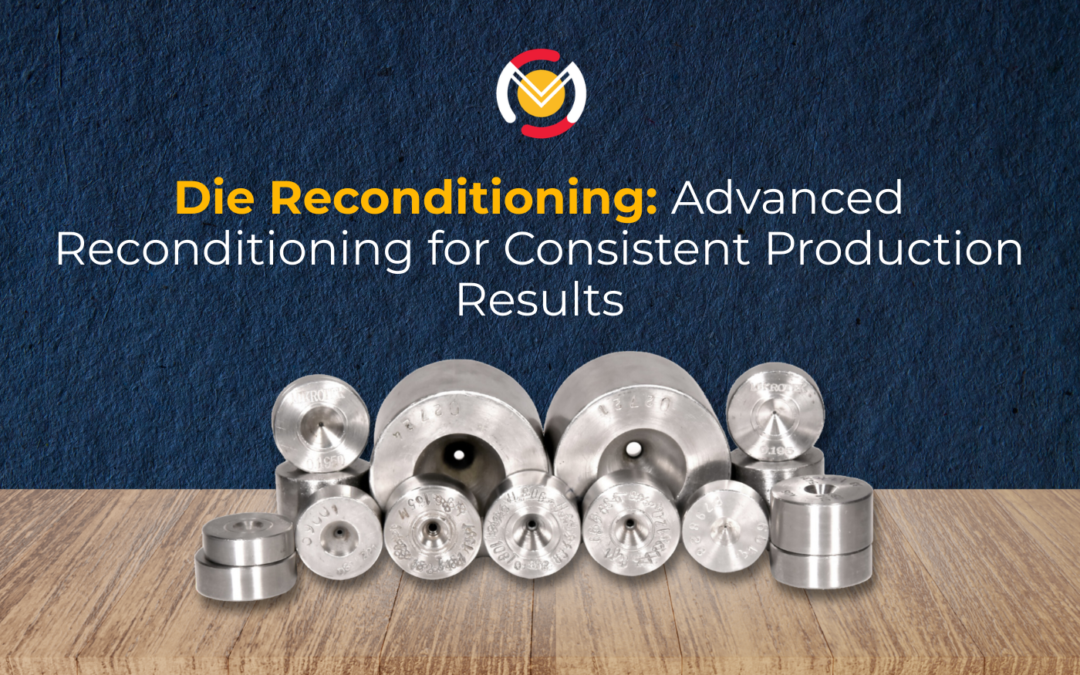
Die Reconditioning restores the life, improves the wire surface finish, and maintains dimensional accuracy in wire drawing operations. Regular inspection, repolishing, and resizing prevent wear expansion, reduce breakages, and support steady production performance.
• Wear ring inspection under a microscope
• Repolishing within tolerance limits
• Resizing for severe wear conditions
• Restoration of profile and roundness
• Quality checks before dispatch
Introduction:
In a wire drawing environment, dies influence every stage of production. Surface finish, dimensional control, and output consistency depend on die condition. Wear begins gradually and becomes visible through performance variation and profile change. A structured approach to Die Reconditioning ensures corrective action at the right time and keeps production stable without unexpected disruptions.
Why does Die Reconditioning play a critical role in wire drawing operations?
Die Reconditioning supports production quality, die longevity, and operational stability. Regular reconditioning restores profile accuracy and maintains performance consistency across drawing cycles.
1. Profile restoration: It helps recover the original geometry of the die profile, which supports dimensional control and process stability during wire drawing.
2. Surface finish improvement: Polished dies reduce friction and support smoother wire movement, resulting in improved surface quality and reduced operational resistance.
3. Operational continuity: Timely reconditioning reduces the chances of unexpected die failure and helps maintain workflow continuity in production environments.
4. Productivity enhancement: Reliable die performance supports steady output and helps maintain process planning without interruptions.
Research published in Materials, a peer-reviewed journal by the Multidisciplinary Digital Publishing Institute (MDPI), highlights how repeated contact stress accelerates surface wear in engineering components, reinforcing the importance of timely Die Reconditioning
How does wear develop and signal the need for Die Reconditioning?
Wear develops gradually at the wire contact point during drawing. A wear ring forms after several miles of operation and becomes a key indicator for reconditioning and repolishing of the dies.
1. Formation of wear ring: Continuous wire movement against the die surface leads to material wear at the contact point and forms a visible wear pattern.
2. Expansion of wear: Delayed attention allows the wear ring to grow, influencing roundness and dimensional accuracy.
3. Risk of cracks: Severe wear may lead to horizontal cracks and early die breakage, affecting production stability.
4. Impact on wire quality: Surface finish and dimensional control vary as wear progresses, influencing output quality and process reliability.
How does repolishing restore performance during Die Reconditioning?
Reconditioning and Repolishing of the dies are preferred when wear remains within tolerance. This process restores the die profile and supports production without changing the size.
1. Microscopic inspection: Quality personnel evaluate wear severity and confirm suitability for repolishing.
2. Profile correction: Polishing restores smoothness and roundness, improving drawing performance.
3. Retention of original size: Repolishing maintains dimensions when wear remains within acceptable tolerances.
4. Operational readiness: Repolished dies return to production with restored performance and consistent output quality.
When does resizing become necessary in Die Reconditioning?
Resizing becomes essential when wear crosses tolerance limits or when profile damage becomes significant. This stage helps restore functional accuracy.
1. Severe wear identification: Inspection reveals the extent of wear and determines the need for resizing.
2. Dimensional correction: Resizing adjusts the die to a suitable size range and prepares it for repolishing.
3. Profile recovery: The refurbishing helps restore the geometry required for smooth wire drawing.
4. Production alignment: Resized dies return to production with stable performance and improved reliability.
How does inspection guide Die Reconditioning before rework begins?
Inspection forms the foundation of the reconditioning. Each die undergoes detailed analysis to determine its current size, wear pattern, and severity.
• Microscope-based evaluation: Quality personnel examine dies under high magnification to understand wear severity and profile condition.
• Size measurement: Accurate measurement confirms current dimensions and tolerance levels.
• Wear pattern interpretation: Detailed observation supports the decision between repolishing and resizing.
• Customer report preparation: Findings documented in a structured report outlining the condition and recommended die refurbishing steps.
How does a production team approach die-refurbishing in real working conditions?
The process begins within the production environment where performance signals guide timely action. The approach focuses on practical observation, technical evaluation, and structured rework that supports stable operations.
1. Performance observation: Operators identify surface variation, dimensional shifts, or drawing resistance during routine production.
2. Technical evaluation: Inspection under magnification helps understand wear pattern, tolerance levels, and profile condition.
3. Revamp decision: Findings guide whether repolishing or resizing is required based on wear severity and production needs.
4. Execution planning: Refurbishing is scheduled in alignment with operational timelines and production continuity.
5. Production readiness: Reconditioned dies return with restored profile accuracy, improved finish, and stable drawing performance.
How does Die Reconditioning improve productivity in a wire plant?
Die Reconditioning supports steady operations, consistent wire finish, and efficient production planning.
1. Stable wire surface quality: Reconditioned dies support smoother drawing and consistent product output across cycles.
2. Dimensional accuracy retention: Profile correction helps maintain roundness and size during operations.
3. Reduced production interruptions: Timely repair keeps dies ready for continuous usage.
4. Improved operational planning: Predictable die performance supports scheduling and workflow alignment.
How does Mikrotek support Die Reconditioning for industrial operations?
Mikrotek performs Die Reconditioning through structured inspection, repolishing, resizing, and quality validation. Skilled inspectors evaluate dies under microscopes and prepare a detailed condition report. Based on inspection, customers receive clarity on whether repolishing or resizing is required. Upon approval, the refurbishing begins with precision restoration and profile correction. Casing cleaning, size marking, and performance validation follow before dispatch.
Conclusion
Die Reconditioning supports consistent production, improved wire quality, and extended die life in wire drawing operations. Structured inspection, repolishing, and resizing ensure performance stability and operational continuity. Mikrotek delivers die refurbishing through detailed evaluation, precision rework, and quality validation designed for sustained productivity and dependable results.
FAQs
1. How does Die Reconditioning begin when production teams notice performance changes?
Die Reconditioning starts when surface finish, dimensional accuracy, or drawing performance shifts become visible. Dies are sent for inspection, and evaluation determines whether repolishing or resizing is required to restore functionality and support production continuity.
3. How does Die Reconditioning help maintain consistent wire quality?
Reconstruction restores the die profile and roundness, smoothens the drawing path, and supports dimensional accuracy. These improvements help maintain surface finish and consistent output during drawing operations.
5. How does Die Reconditioning support long-term production planning?
Structured revamping ensures dies remain functional, reliable, and ready for continuous use. Inspection, repolishing, and resizing help maintain performance standards and support operational efficiency across production stages.
2. What role does inspection play in Die Reconditioning decisions?
Inspection identifies wear severity, size condition, and profile variation through microscopic evaluation. Findings guide and help prepare a detailed customer report before execution begins.
4. When should a business plan Die Reconditioning for best results?
Planning begins once wear signs appear or after extended drawing cycles. Regular intervals support timely correction and prevent damage that may influence production quality and die life.