

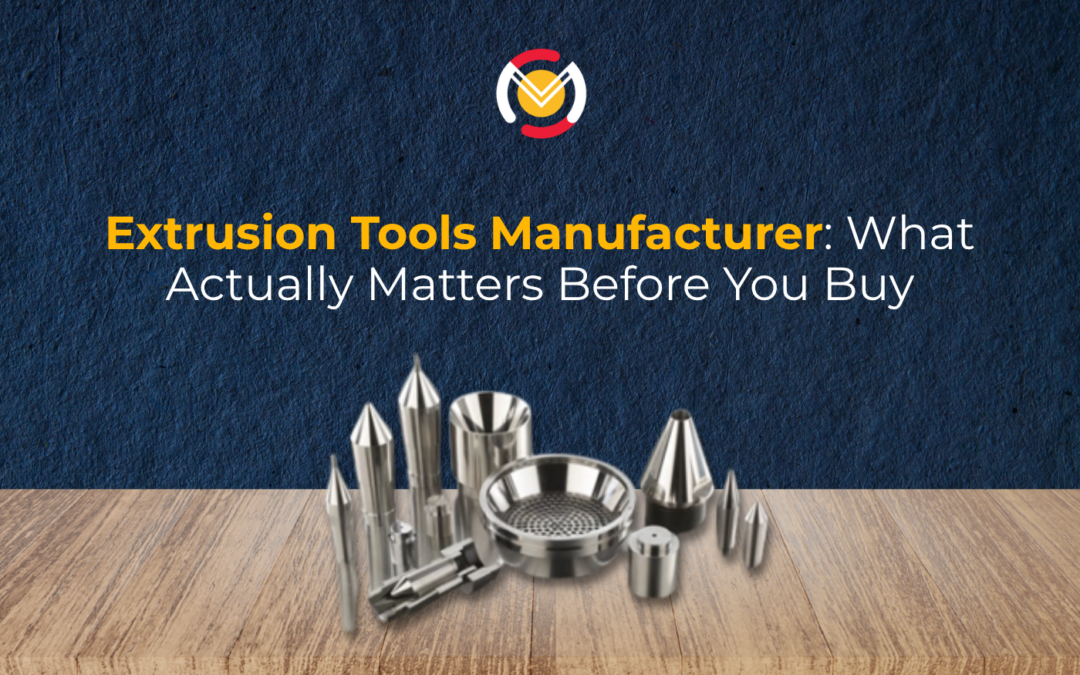
An extrusion tools manufacturer produces precision components, tips, dies, and crossheads, that control conductor positioning and insulation flow in cable extrusion lines. These tools directly determine cable quality, concentricity, and production efficiency. Choosing the right manufacturer impacts your rejection rates, downtime, and long-term operating costs.
Material Selection Drives Performance: Tool steel suits lighter applications, carbide inserts extend life in high-wear areas, and diamond inserts handle high-speed, abrasive conditions. Your wire type and operating conditions should guide material selection, not just initial cost.
High-Precision Engineering Prevents Production Issues: Concentricity control, tolerance accuracy, surface finish quality, and dimensional stability are non-negotiable. Even minor variations cause uneven insulation and higher rejection rates.
Proper Tooling Decreases Operational Costs: High-quality tools preserve stable performance and limit downtime through extended tool life. Poor tooling forces regular stoppages and drives up the cost per meter.
Application-Specific Design Matters: Tools must be customized for your specific crosshead system and operating conditions. Before ordering, determine which materials suit your application, the tolerance levels you maintain, and the expected tool life.
Maintenance Extends Tool Life Significantly: Regular measurement detects wear early, clean storage prevents contamination, and proper handling avoids surface damage. Consistent maintenance maximizes your tooling investment throughout extended cycles.
Introduction:
In a cable extrusion line, what happens inside the tooling defines performance. The conductor needs to stay perfectly centered, insulation has to flow evenly, and the final cable must meet strict dimensional and quality standards. When these conditions fail, the machine is rarely the issue; it’s the tooling.
A reliable extrusion tool manufacturer ensures consistent production quality and long-term efficiency. in determining process stability, line stoppages, and output consistency. The tools may be small, but they have a significant impact on production quality, rejection rates, and output.
Choosing the right manufacturer isn’t simply about making a purchase; it’s a long-term production strategy.
How to Choose the Right Extrusion Tools Manufacturer
A capable extrusion tool manufacturer delivers a complete system for controlling conductor positioning, insulation flow, and cable geometry. These components work together to ensure consistent and reliable production.
1. Extrusion Tips: Extrusion tips guide the conductor precisely to the center of the die. Manufacturers make them using tool steel, carbide inserts, and diamond inserts depending on the application. Well-designed tips secure precise centering, high concentricity, and stable performance during extended production runs.
2. Extrusion Dies: Extrusion dies define the outer insulation profile. Precision machining and mirror-level polishing provide smooth material flow and uniform insulation thickness, even at high speeds.
3. Crossheads: Crossheads hold the tip and die in perfect alignment. Even slight misalignment may cause eccentric insulation. They come in single-, dual-, and triple-insulated configurations, including both manual and self-centering designs to meet different production needs.
4. Distributors: Distributors ensure uniform plastic flow around the conductor at 360 degrees. Without proper distribution, you cannot achieve consistent insulation thickness.
Their design focuses on compact performance, accurate profiles, and long service life.
Why Precision Is Inflexible in Extrusion Tooling
Extrusion tooling operates under continuous heat, pressure, and speed. Even minor variations might lead to significant production issues.
1. Concentricity Control: Maintaining perfect centering of the conductor continues to be critical. Any deviation results in uneven insulation and potential performance failures.
2. Tolerance Accuracy: Tip-and-die dimensions must remain within tight tolerances throughout their lifecycle to ensure consistent output.
3. Surface Finish Quality: A highly refined surface reduces drag and provides smooth material flow, which prevents defects.
4. Dimensional Stability: Tools must maintain their geometry over long production runs to avoid frequent adjustments and instability.
A reliable extrusion tool manufacturer makes sure these factors stay consistently controlled during production.
According to insights published on ScienceDirect, the extrusion process relies heavily on die design and tooling precision to control material flow and achieve accurate final product dimensions.
This is why choosing an experienced extrusion tools manufacturer is critical for maintaining consistent production standards.
The Role of Material Selection in Tool Efficiency
Material selection isn’t a cost decision; it’s a performance decision.
Different materials behave differently under production stress. Selecting the wrong one increases wear, downtime, and rejection rates.
1. Tool Steel: Tool steel is well-suited for lighter applications and lower speeds, where frequent tool changes are manageable.
2. Carbide Inserts: Manufacturers use carbide inserts in high-wear areas to extend tool life and improve durability without replacing the entire tool.
3. Diamond Inserts: Diamond inserts work best for high-speed and abrasive applications. They offer superior wear resistance, reduced friction, and improved surface finish over long production cycles.
An experienced extrusion tools manufacturer recommends materials based on actual operating conditions to provide optimal performance and cost efficiency.
How Extrusion Tools Impact Production Efficiency
Extrusion tools directly influence how efficiently a cable plant operates. They control both material flow and conductor positioning throughout the process.
Poor tooling leads to regular stoppages, inconsistent quality, higher rejection rates, and increased reliance on operator adjustments. Over time, this reduces productivity and increases operating expenses. High-quality tooling delivers measurable improvements:
1. Stable Production Runs: Tools maintain uniform performance over long production cycles. This reduces the requirement for frequent adjustments and enables smooth, steady operation.
2. Improved Output Quality: Uniform insulation thickness and smooth surface finish minimize defects. This secures consistent product quality across batches.
3. Reduced Downtime: Extended tool life reduces changeovers and unplanned interruptions. Production lines can operate more efficiently as a result.
4. Lower Cost Per Meter: Efficient tooling improves output consistency and reduces material waste. This results in decreased production costs over time.
What You Should Ask Before Choosing an Extrusion Tool Manufacturer
Many tooling issues start at the ordering stage due to partial or ambiguous specifications.
1. Before placing an order, you should clarify
2. Which material works best for your application
3. Whether the tools are customized for your existing crosshead
4. What tolerance levels does the manufacturer maintain?
5. Expected tool life under your conditions
6. Manufacturing and quality control processes
A reliable extrusion tools manufacturer provides clear, application-specific answers rather than standard responses.
Maintenance: Extending the Life of Your Extrusion Tools
Even the best extrusion tools require proper handling and monitoring to achieve their full service life.
1. Regular Measurement: Periodic inspection helps detect wear early. This allows corrective action before it affects production quality.
2. Clean Storage: Removing residual material and storing tools in clean conditions secures consistent performance in future runs.
3. Proper Handling: Cautious handling and separate storage prevent surface damage that can impact flow and concentricity.
4. Reconditioning: Regrinding and polishing at the right stage can restore tool efficiency and extend usability.
Consistent maintenance secures stable performance and reliable production throughout extended cycles.
How Mikrotek Delivers Reliable Extrusion Tooling
Mikrotek manufactures a complete range of extrusion tools made for precision and durability in cable production. With over three decades of experience, the company focuses on accurate conductor centering, uniform insulation flow, and consistent tooling performance. Each tool undergoes strict dimensional control and is aligned with specific production requirements. This includes wire type, size, and operating conditions.
The product range includes tips, dies, crossheads, distributors, and allied tools. All components integrate fluently with existing systems. This solution helps manufacturers achieve stable production, reduced downtime, and consistent output quality across applications.
Working with a professional extrusion tools manufacturer improves long-term performance.
Conclusion
Mikrotek delivers extrusion tools designed for precision, durability, and consistent cable quality. The range includes tips, dies, and tooling that ensure accurate conductor centering and uniform insulation flow. Tight control over dimensions and material selection, including tool steel and carbide variants, supports stable performance. Built to match existing crosshead systems, Mikrotek tools help maintain reliable and efficient production across multiple wire types.
For More information, connect with us.
FAQs
1. What does an extrusion tool manufacturer do?
An extrusion tools manufacturer produces tips, dies, crossheads, and distributors used in cable extrusion lines. These components control the positioning of conductors and the flow of insulation. They directly determine cable quality, concentricity, and production efficiency.
3. Which materials are used in extrusion tools?
Manufacturers make extrusion tools using tool steel, carbide inserts, and diamond inserts. The selection depends on wire type, speed, and wear conditions. This directly influences tool durability and the quality of the finished cable.
5. Do extrusion tools have to match the crosshead?
Yes, tools must match the exact crosshead system used in production. Incorrect fit leads to misalignment. This affects concentricity, insulation thickness, and overall cable quality from the beginning of the process.
7. How can you identify worn extrusion tools?
Worn tools exhibit signs such as inconsistent concentricity, surface defects, and increased rejection rates. Regular measurement and inspection help identify wear early. This happens before it impacts production quality and operation.
9. How does Mikrotek ensure consistent tooling performance?
Mikrotek follows strict dimensional control and application-based design for each tool. The company aligns tooling specifications with production conditions. This secures consistent performance, longer life, and reliable results throughout different cable manufacturing applications.
2. Why is concentricity important in cable extrusion?
Concentricity maintains uniform insulation thickness around the conductor. Poor centering leads to uneven insulation. This can cause electrical failures, lower performance, and rejection of finished cables during testing or actual use.
4. How do extrusion tools affect production efficiency?
High-quality tools reduce downtime, keep consistent performance, and improve output quality. Poor tooling leads to frequent adjustments, higher rejection rates, and elevated operational costs across the entire production process.
6. What are distributors in extrusion tools?
Distributors ensure uniform plastic flow around the conductor at 360 degrees. They play a key role in preserving uniform insulation thickness. They also prevent uneven material distribution during the extrusion process.
8. Can extrusion tools be reconditioned?
Yes, you can regrind and polish extrusion tools to restore performance. Reconditioning extends tool life and reduces replacement frequency. It maintains consistent production quality when done at the appropriate stage.
10. How does Mikrotek help in selecting the right extrusion tools?
Mikrotek evaluates wire type, size, and operating conditions before recommending tooling solutions. This ensures the correct design, material selection, and performance alignment. It leads to consistent and productive production from the start.
