
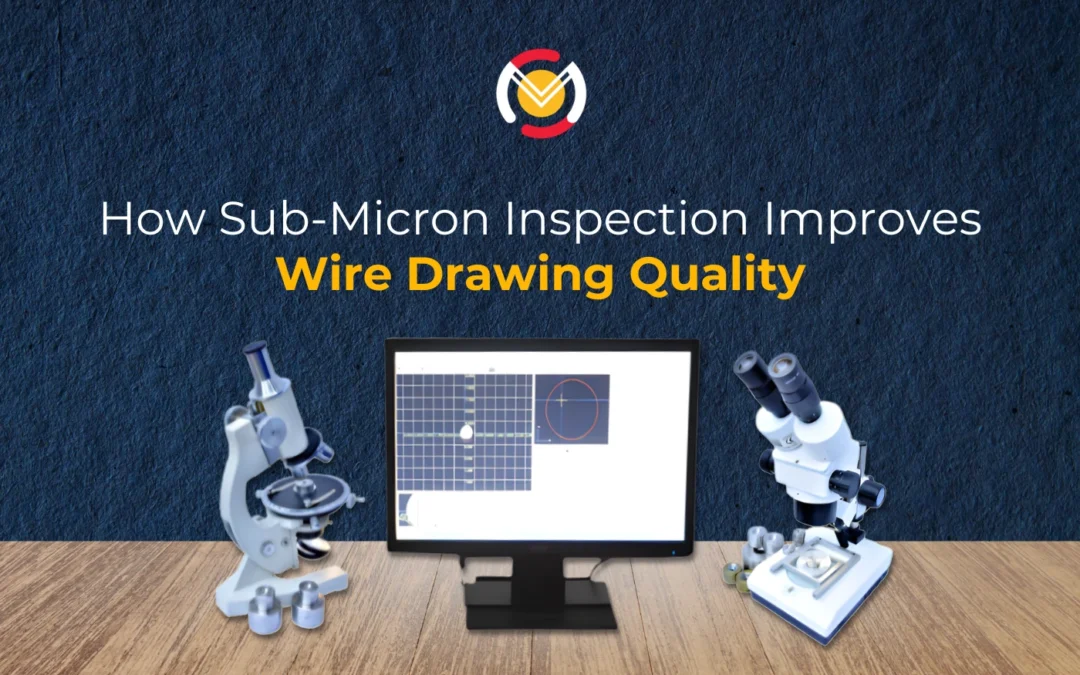
Wire drawing operations today depend on precise measurements, accurate deformation control and stable tooling to deliver consistent performance across multiple production stages. As industries shift toward finer diameters, tighter tolerances and advanced material applications, manufacturers must adopt modern inspection systems that enhance wire drawing quality and increase long term reliability. Small changes in die geometry, alignment, polishing condition or lubrication can create irregularities that weaken performance. These errors affect productivity, increase scrap and reduce the overall strength of the final wire product.
Inspection technologies built with sub-micron precision offer manufacturers greater control over deformation, surface stability and dimensional accuracy. By monitoring die condition, diameter variation and drawing behaviour, these systems help maintain stable operations. From digital gauges and die inspection microscopes to optical sensors and trend monitoring tools, the latest technologies are designed to strengthen wire drawing quality under high speed industrial environments.
Wire drawing facilities across automotive, aerospace, medical, electronics and energy sectors increasingly depend on measurement tools that deliver the accuracy necessary to support wire drawing quality at global manufacturing standards. When precision becomes part of everyday operations, productivity improves and defects decline.
How Precision Measurement Supports Wire Drawing Quality
Wire drawing is the process of reducing metal diameter under controlled deformation. The quality of deformation depends on smooth die surfaces, accurate approach angles, stable bearing zones and consistent lubrication. These factors influence final performance. To maintain wire drawing quality, manufacturers must identify small shifts before they evolve into dimensional errors or surface defects.
High precision applications such as medical guidewires, aerospace, fasteners, transformer windings and battery connectors require extremely tight tolerances. These components rely on process control capable of sub micron precision to ensure consistent outcomes. Inspection systems help engineers detect micro level issues early, preserving wire drawing quality throughout the entire reduction schedule.
Continuous inspection as the wire moves through multiple dies helps prevent scrap, stabilize dimensional accuracy and maintain ideal surface finish.
Inspection Tools That Improve Wire Drawing Quality
Modern inspection systems form a complete ecosystem that supports wire drawing quality across every production stage. Each tool serves a different purpose and together they ensure consistent results.
Digital Diameter and Ovality Gauges
Digital gauges provide high resolution measurements of diameter in real time. They detect fluctuations caused by wear, lubrication issues, thermal effects or material inconsistencies. Ovality gauges ensure the wire remains round throughout drawing. This combined feedback prevents defects that weaken performance.
Die Inspection Microscopes
Mikrotek’s die inspection microscopes such as MC1.26, MXT, and MTCM give technicians a clear view of die profile conditions across fine and medium wire ranges. These systems help identify micro cracks, polishing irregularities, taper deviations and surface defects that may influence drawing stability during production. Each model is designed for a specific die material and inspection requirement, creating a complete solution for maintaining wire drawing quality.
- MXT – Stereoscopic Zoom Microscope
The MXT model is built for critical examination of reduction angles, bearing lengths and the internal geometry of both diamond and tungsten carbide dies.
Its stereoscopic design provides a high clarity view of the die interior, making it ideal for detailed geometric assessment where precision angles and bearing quality influence wire drawing performance.
Technical Features:
• Range: 0.100 mm to 15 mm
• Standard magnification: 7x to 45x
• Optional magnification: up to 180x
• Stereoscopic zoom lenses for enhanced visibility
Use Case:
Best suited for evaluating medium to large die sizes, identifying wear patterns and ensuring smooth metal flow during drawing.
2. MC1.26 – Monocular Diamond Die Inspection Microscope
The MC1.26 is designed specifically for diamond dies, offering full inspection of the die profile from top to bottom.
Its fixed magnification options make it suitable for fine size dies that require precise evaluation of polishing quality and dimensional accuracy.
Technical Features:
• Range: 0.010 mm to 1.5 mm
• Magnification: 25x, 50x, 100x (fixed)
Use Case:
Ideal for detecting micro cracks, polishing inconsistencies and deviations that can affect stability in fine wire drawing applications.
3. MTCM – Monocular Tungsten Carbide Die Inspection Microscope
The MTCM model is engineered for examining tungsten carbide dies, focusing on reduction angles, bearing lengths and overall die profile integrity.
Its magnification range supports accurate evaluation of TC die wear, helping technicians identify early shifts in geometry.
Technical Features:
• Range: 0.100 mm to 6.0 mm
• Magnification: 5x, 10x, 25x
Use Case:
Used to visualize wear rings, taper shifts and surface refinement needs in TC dies, ensuring stable drawing performance and predictable wire quality.
Digital Diameter Gauge Systems
For dimensional verification during die inspection, the Digital Diameter Gauge available in MDDG F and MDDG M models provides quick and accurate optical measurements. Each die can be checked within a few seconds, ensuring that approach zones, bearing diameters and exit profiles are within the required tolerance before drawing begins.
Measuring Pin Sets
Mikrotek’s measuring pin sets support die inspection by validating bore size and confirming calibration with micron-level tolerance. These hardened, sub-zero treated pins provide reliable size confirmation and are essential for maintaining consistency in die preparation.
Laser and Optical Sensors
Laser micrometres measure diameter and movement without contact. High sampling rates help detect vibration, drift or path deviation that could affect results. These systems maintain stability for fine wire and high-speed operations. There are certain metrology standards to refer to.
Common Factors That Influence Wire Drawing Quality
Several variables can influence dimensional stability and surface finish:
- Wear rings in the bearing
- Changes in approach angle geometry
- Lubrication inconsistencies
- Alignment issues between die and capstan
- Thermal expansion
- Contamination inside the die
- Over polishing or improper finishing
- Wire vibration caused by unstable tension
Sub-micron precision measurement helps catch these issues early and maintain stable performance.
How Sub Micron Inspection Supports Zero Defect Production
Achieving zero defect output requires continuous monitoring and rapid corrections. Sub-micron inspection strengthens process control in several ways.
Pre-Production Validation
Before drawing begins, dies are examined for geometry, polishing quality and damage. This step prevents early failures that could undermine wire drawing quality.
Industries That Require High Wire Drawing Quality
Many sectors rely on precise performance to ensure safety and functionality. These include:
- Medical device manufacturing
- Aerospace components
- Automotive cables and fasteners
- High speed telecom conductors
- Stainless steel precision springs
- Power systems
- EV connectors
- Magnet wire
Applications in these industries require stable processes and consistent dimensional control.
Benefits of Strengthened Inspection for Wire Drawing Quality
Improved inspection and measurement capabilities lead to:
- Lower defect rates
- Better surface finish
- Stable dimensional accuracy
- Fewer interruptions
- Extended die life
- Reduced waste
- Higher production speeds
- Strong compliance with OEM specifications
These benefits show why modern plants treat inspection as a strategic investment.
Conclusion:
Wire drawing quality is now one of the most important performance indicators in global manufacturing. Inspection tools built with sub micron precision help detect geometric drift, diameter variation and surface irregularities before they lead to waste or instability. Consistent measurement strengthens wire drawing quality by ensuring that every die enters production with the correct geometry, stable surface finish and proper calibration. When dies are maintained at the right condition, tool life increases, wire flow becomes predictable, and production remains stable across long runs.
Mikrotek provides precision dies, metrology systems and inspection equipment designed to support wire drawing quality at every stage of production. From diamond dies and tungsten carbide dies to advanced digital gauges and die inspection microscopes, every solution is engineered to keep tooling reliable and consistent. Adopting an organized inspection routine for dies is essential for long term reliability and sustained performance.
FAQs
1. What is wire drawing quality?
It refers to dimensional accuracy, surface finish and consistency achieved during wire drawing.
2. Why is precision measurement essential?
It helps detect variations early and strengthens overall process control.
3. Which tools improve wire drawing output?
Digital gauges, inspection microscopes and optical sensors support accuracy in high-speed production.
4. How does real time monitoring help?
Continuous data ensures deviations are corrected without delay.
5. Can predictive maintenance reduce defects?
Yes. It prevents tool failure and stabilizes long term performance.