

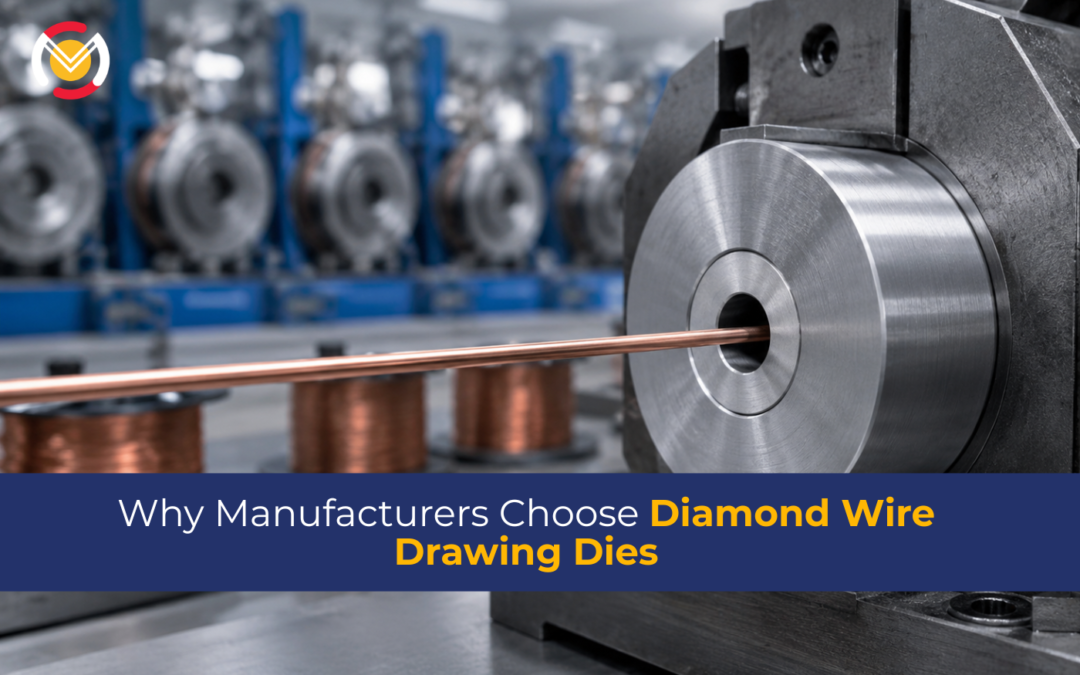
Leading wire manufacturers are switching to high-performance Diamond wire drawing dies because these dies offer longer die life, better roundness retention, and fewer production interruptions.
Diamond wire drawing dies help manufacturers maintain wire quality across stainless steel, copper, aluminium, welding wire, medical wire, alloy wire, and other demanding applications.
Key points:
1. Diamond wire drawing dies support consistent wire size, finish, and roundness.
2. High-performance drawing dies reduce downtime in wire drawing machines.
3. These dies are suitable for wet drawing, dry drawing, cold drawing, and hot drawing.
4. PCD blanks are available in multiple grain sizes for different applications.
5. Mikrotek manufactures Diamond wire drawing dies as per customer-ordered specifications.
For wire manufacturers, consistency is where profit often gets protected. A wire may pass through several stages, but the drawing die is where accuracy, finish, and roundness are closely controlled.
When production volumes increase, ordinary die performance can quickly become a limitation. Frequent die wear leads to more inspections, more changeovers, and less predictable output.
This is where high-performance Diamond wire drawing dies make a clear difference.
These dies are designed for demanding applications such as stainless steel, medical wires, low and high-carbon steel, welding wire, copper and aluminium conductors, magnet wire, EDM wire, molybdenum wire, coated wire, alloy wire, and more. Each of these materials needs a die that can handle pressure, speed, friction, and repeated drawing cycles.
For most buyers, the shift begins with a simple need: better control on the shop floor. They want dies that last longer, hold roundness better, reduce stoppages, and match exact drawing requirements. High-performance Diamond wire drawing dies help answer that need with stronger wear resistance and application-based customization.
Why Do Wire Manufacturers First Look at Die Performance?
Wire manufacturers look at die performance first because the die directly controls wire diameter, roundness, finish, and drawing stability. When the die wears faster, the entire production process becomes harder to control.
1. Wire roundness matters: Diamond wire drawing dies help retain roundness for a long time. This supports better wire consistency and reduces the risk of uneven output during continuous production.
2. Surface finish matters: A well-selected Diamond wire drawing die helps the wire pass smoothly through the die profile. This supports a cleaner wire finish and reduces surface-related quality concerns.
3. Machine uptime matters: Frequent die changes interrupt production. High-performance wire drawing dies reduce downtime by maintaining the working profile for a longer period.
For wire manufacturers, the die is a small component with a large impact. When the die performs well, the drawing machine runs with better stability and fewer avoidable interruptions.
How Do Diamond Wire Drawing Dies Help Reduce Downtime?
Diamond drawing dies reduce downtime by offering better wear resistance and longer die life. When a die holds the required profile for a longer time, the production team spends less time stopping machines for inspection, correction, or replacement.
Downtime usually begins with small signs. The wire finish may change. The diameter may shift. The machine may need more frequent checks. The operator may notice that the die no longer supports stable drawing.
High-performance Diamond wire drawing dies help control these issues. These dies support long production runs and maintain roundness for a longer time. This gives manufacturers better control over machine availability.
1. Fewer stoppages: A strong diamond die reduces repeated machine stops caused by die wear. This helps the production floor maintain better drawing continuity.
2. Better planning: Longer die life helps teams plan die replacement and maintenance more effectively. Sudden interruptions reduce when die performance is predictable.
3. Improved productivity: When drawing machines run for longer periods without die-related delays, production output becomes easier to manage.
For high-volume wire manufacturers, reduced downtime is one of the strongest reasons to switch to Diamond wire drawing dies.
Studies on wire drawing show that die design, lubrication, and drawing speed play a major role in friction control and drawing performance.
Why Are These Wire Drawing Dies Suitable for Different Wire Applications?
Diamond wire drawing dies are suitable for different wire applications because the material offers strength, wear resistance, and flexibility across multiple drawing conditions. These dies can be customized based on wire material, drawing speed, surface requirement, and die life expectation.
Mikrotek’s wire drawing dies are used for stainless steel, medical wires, low and high-carbon steel, welding wire, copper and aluminium conductors, magnets, EDM tungsten, molybdenum, coated wires, alloy wires, and more.
1. Stainless steel wires: Stainless steel drawing needs dies that can manage wear and maintain surface quality. Diamond dies support consistent performance in such demanding applications.
2. Copper and aluminium conductors: Conductors require controlled drawing and smooth finish. Diamond dies help maintain stable wire quality across long production runs.
3. Medical and fine wires: Medical wire applications need accuracy and consistency. Diamond dies can support smaller sizes and careful profile control.
4. Welding and alloy wires: These materials can create demanding drawing conditions. High-performance Diamond dies help maintain production stability under such requirements.
This wide application range makes Diamond dies a practical choice for manufacturers handling multiple wire types.
How Do Wet, Dry, Cold, and Hot Drawing Requirements Affect Die Selection?
Drawing conditions affect die selection because every process places different pressure, heat, and friction demands on the die. A die that works well in one application may not be the right fit for another.
Diamond wire drawing dies are suitable for both wet and dry drawing. These dies are also suitable for cold and hot drawing when the right blank type and profile are selected.
1. Wet drawing: Wet drawing uses lubrication to control heat and friction. Diamond dies support smoother wire movement when the die profile matches the application.
2. Dry drawing: Dry drawing can place more stress on the die. High-performance Diamond wire drawing dies help manage wear and maintain drawing stability.
3. Cold drawing: Cold drawing needs strong dimensional control. Diamond dies help maintain size, roundness, and surface finish during repeated drawing cycles.
4. Hot drawing: Hot drawing requires the right diamond blank selection. Some blanks can withstand high temperatures and special working conditions.
For manufacturers, die selection must match the process. The right Diamond wire drawing die improves drawing control and supports longer die life.
Research on wire drawing die wear shows that die geometry, drawing speed, and friction directly influence die life and drawing stability.
How Do Diamond Blanks and Grain Sizes Influence Die Performance?
Diamond blanks influence die performance because the blank structure affects wear resistance, finish, and application suitability. PCD blanks are manufactured through a high-temperature and high-pressure process.
During this process, cobalt is used as a binder between synthetic diamond particles. These blanks are called metal-filled blanks and can withstand temperatures up to 650°C. For higher temperature and special applications, cobalt can be leached out. These blanks are called thermally stable blanks and can withstand temperatures up to 1200°C.
PCD blanks are available in two types: self-supported and tungsten ring-supported. These blanks also come in different grain sizes such as 1, 3, 5, 10, 25, and 50 microns.
1. Fine grain sizes: Fine grain sizes are often preferred when surface finish and smaller wire sizes are important. These blanks help support a cleaner finish and detailed control.
2. Coarser grain sizes: Coarser grain sizes are often selected for stronger wear resistance and heavier drawing conditions. These blanks suit applications where die life is a major priority.
3. Application-based selection: The right grain size depends on wire material, drawing speed, surface need, temperature condition, and expected die life.
This is why Diamond wire drawing dies should be selected with application clarity. A good die starts with the right blank.
Why Do Customized Profiles Matter in Diamond Wire Drawing Dies?
Customized profiles matter because every wire drawing line has different requirements. Wire material, drawing speed, lubrication, temperature, final diameter, and surface finish all affect die design.
Mikrotek manufactures Diamond wire drawing dies as per customer-ordered specifications. This helps manufacturers get dies that match their exact production needs instead of using a general die design for every application.
Better drawing control: A customized profile helps control how the wire moves through the die. This supports better drawing stability and smoother production.
Improved wire finish: When the profile matches the application, the wire can pass through with better surface control. This helps reduce finish-related issues.
Longer die performance: The right profile can reduce unnecessary stress on the die. This helps improve die life and reduce frequent corrections.
Repeatable results: Once the correct profile is finalized, manufacturers can maintain consistent specifications across future orders.
For B2B wire manufacturers, customization is a major advantage. A die designed for the actual process performs better than a standard guess-based selection.
What Should Buyers Check Before Choosing Diamond Wire Drawing Dies?
Buyers should check wire material, die size range, drawing method, surface finish requirement, drawing speed, blank type, grain size, and expected die life before selecting Diamond wire drawing dies.
1. Die size range: Mikrotek manufactures polycrystalline diamond dies in the range of 0.025 mm to 30.000 mm. Buyers should match the die size to current and future production needs.
2. Wire material: Different materials need different die considerations. Stainless steel, copper, aluminium, welding wire, medical wire, EDM wire, and alloy wire may require different profiles and blanks.
3. Drawing condition: Wet, dry, cold, and hot drawing conditions must be considered before choosing the die. The wrong selection can reduce performance.
4. Grain size: The grain size should match the required finish and wear resistance. Fine and coarse grains serve different production needs.
5. Supplier guidance: A reliable supplier should understand the customer’s application before recommending the die. This helps avoid incorrect selection and repeated die issues.
When buyers check these points clearly, these wire drawing dies become a stronger long-term production investment.
How Does Mikrotek Support High-Performance Diamond Wire Drawing Dies?
Mikrotek manufactures Diamond wire drawing dies based on customer-ordered specifications. The company offers dies in the range of 0.025 mm to 30.000 mm and supports a wide range of wire drawing applications.
Mikrotek’s polycrystalline diamond dies are used for stainless steel, medical wires, low and high-carbon steel, welding wire, copper and aluminium conductors, magnets, EDM tungsten, molybdenum, coated wires, alloy wires, and more.
The company sources polycrystalline diamond blanks from well-known manufacturers, including Sandvik Hyperion, formerly Diamond Innovations or GE, Sumitomo, and other reputed manufacturers. Compax, produced by Sandvik Hyperion, is widely used in the wire and cable industry.
Mikrotek also recommends the proper selection of diamond blanks based on surface requirement, drawing speed, die life, and application conditions. This makes the buying process easier for manufacturers who want dies that match actual production needs.
For manufacturers switching to high-performance Diamond wire drawing dies, Mikrotek offers application understanding, customized profiles, and production-focused die selection.
What Is the Final Takeaway for Wire Manufacturers?
High-performance Diamond wire drawing dies help wire manufacturers improve die life, reduce downtime, retain roundness, and support consistent wire quality. These dies are suitable for multiple materials, drawing conditions, and industrial applications.
For buyers, the decision should begin with the application. Wire material, drawing speed, finish requirement, die size, grain size, and blank type should guide the selection.
Mikrotek supports this journey by manufacturing these wire drawing dies as per customer-ordered specifications and recommending the right blank based on real production needs.
FAQs
What are Diamond wire drawing dies used for?
Diamond wire drawing dies are used to reduce and control wire diameter during the wire drawing process. These dies help maintain roundness, surface finish, and size consistency across stainless steel, copper, aluminium, welding wire, medical wire, and alloy wire applications.
Why are wire manufacturers switching to high-performance Diamond wire drawing dies?
Wire manufacturers are switching to high-performance Diamond drawing dies because these dies offer longer die life, better roundness retention, reduced downtime, and better production consistency. This helps manufacturers improve machine uptime and maintain wire quality across long runs.
Are Diamond wire drawing dies suitable for wet and dry drawing?
Yes, Diamond dies are suitable for both wet and dry drawing. The die profile and blank selection should match the wire material, lubrication condition, drawing speed, and required surface finish for better performance.
Can Diamond wire drawing dies be used for cold and hot drawing?
Yes, Diamond wdies can be used for cold and hot drawing applications. Metal-filled blanks can withstand temperatures up to 650°C, while thermally stable blanks can withstand temperatures up to 1200°C for special applications.
What grain sizes are available in diamond blanks?
correct grain size depends on wire material, drawing speed, surface finish requirement, temperature condition, and expected die life.
Why is roundness retention important in Diamond wire drawing dies?
Roundness retention is important because wire quality depends on stable die geometry. When diamonds die, retaining roundness for a longer time, manufacturers can reduce variation and maintain better consistency during continuous production.
How does Mikrotek manufacture Diamond wire drawing dies?
Mikrotek manufactures wire drawing dies as per customer-ordered specifications. The company offers polycrystalline diamond dies from 0.025 mm to 30.000 mm and recommends suitable blanks based on drawing speed, surface needs, and die life.
What should buyers check before ordering Diamond drawing dies?
Buyers should check wire material, die size, drawing method, surface finish, drawing speed, blank type, grain size, temperature requirement, and expected die life. These factors help select Diamond wire drawing dies that match real production needs.
Are Diamond wire drawing dies suitable for medical wires?
Yes, Diamond dies are suitable for medical wire applications where accuracy, surface finish, and consistency are important. The correct profile and grain size selection help support stable drawing for fine and precision wire requirements.
Why should manufacturers choose Mikrotek for Diamond dies?
Manufacturers can choose Mikrotek for Diamond dies because the company offers customized specifications, a wide die size range, reputed diamond blank sourcing, and application-based guidance for surface finish, drawing speed, and die life requirements.
